Ra
Re
Ra is the principal solar deity of ancient Egypt, worshipped as the creator of the world and king of the gods. He embodies the life-giving power of the sun and its daily journey across the sky. His cult spanned more than three millennia of Egyptian civilization.
Key Facts
- Worshipped since the Old Kingdom (c. 2686 BCE) as the god of the sun and creator of all things
- Merged with the god Amun to form Amun-Ra during the New Kingdom (c. 1550 BCE)
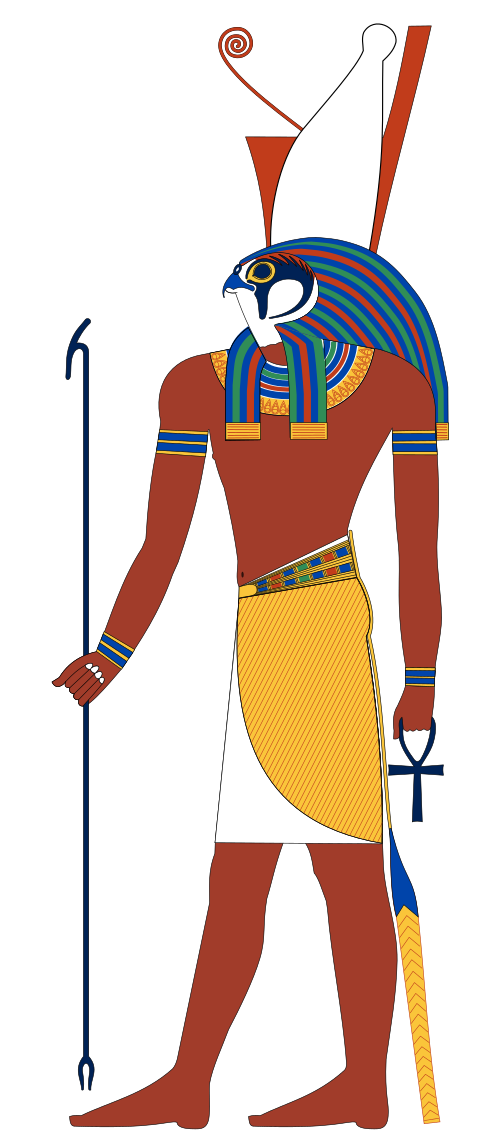
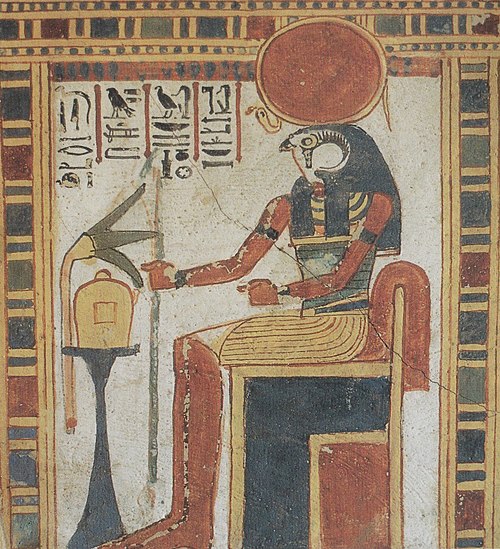
- Depicted with a falcon's head crowned by a solar disk in Egyptian iconography
- His daily voyage across the sky and through the underworld aboard the solar barque forms the backbone of Egyptian cosmology
- His main cult center was at Heliopolis, one of the most important sanctuaries in ancient Egypt
Works & Achievements
According to Egyptian mythology, Ra is the creator who brought forth the world and all the gods from himself. This cosmogony places Ra at the center of Egyptian theology as the primordial source of all existence.
Ra crosses the sky each day aboard a solar barque, symbolizing the eternal cycle of life, death, and resurrection. This mythology explains astronomical phenomena and structures the Egyptian understanding of time.
Every night, Ra fights the serpent of chaos Apophis in the Amduat (the underworld). This mythological battle represents the perpetual victory of order (Ma'at) over chaos, and justifies the necessity of the day-night cycle.
During the New Kingdom, Ra merged with Amun, the hidden god, forming Amun-Ra, the supreme deity of Egypt. This syncretism reinforced the religious authority of the pharaoh, who was regarded as the son of Ra.
The cult of Ra at Heliopolis (Iunu) became one of the most important in ancient Egypt, shaping pharaonic theology for three millennia. The pharaohs adopted the title of son of Ra to legitimize their divine power.
Ra is depicted with a falcon head crowned by the solar disk, symbolizing his power and dominion. This imagery became one of the most recognizable symbols of Egyptian mythology.
The cult of Ra shaped the Egyptian calendar, which was based on the annual solar cycle and organized the seasons (Akhet, Peret, Shemu) and religious festivals. This calendrical structure influenced agriculture and civic life.
Anecdotes
Ra was depicted with the head of a falcon crowned by the solar disk. Each day, the Egyptians believed that Ra crossed the sky in his solar barque, bringing light and life. This belief was so important that it structured the Egyptian calendar and religious rituals.
The name of Ra was considered so powerful that the Egyptians kept it secret. According to New Kingdom texts, knowing the true name of a god gave power over him. This practice shows the major importance granted to Ra in the Egyptian divine hierarchy.
Ra was merged with Amun to form Amun-Ra, an even more powerful deity. This fusion, especially popular during the New Kingdom, represented the union of the hidden creator god (Amun) and the visible solar god (Ra), showing how the Egyptians adapted their mythology.
The Egyptians believed that every night, Ra journeyed through the Duat (the Underworld) aboard his barque, battling the chaos serpent Apophis. This nocturnal voyage was just as important as his daytime journey, as it represented the eternal cycle of creation and renewal.
The temple of Heliopolis was the main center of Ra's cult in ancient Egypt. Pharaohs built obelisks pointing toward the sky to honor Ra and affirm their divine connection with him, a practice that lasted more than three thousand years.
Primary Sources
Glory to you, Ra, at your rising! Glory to you who rise as Khepri! You have accomplished your transformation and shine upon the horizon of the sky. Your eye is the sun that spreads its light across the earth.
Unas ascends to the sky with Ra. Unas travels in the solar barque of Ra. Unas is Khepri, the morning form of the sun god who renews his creation each day.
Adoration to you, Amun-Ra, king of all the gods! You are the creator of all things; you illuminate the earth with your golden rays and journey across the sky in your eternal barque.
Ra-Horakhty shines in his splendor upon the golden throne. His solar disc lights up the Two Lands, and his life-giving rays reach even into the dwellings of the dead.
Under the protection of Ra, king of the gods, Pharaoh Ramesses II concludes the eternal alliance. May Ra watch over this treaty for all eternity.
Key Places
The main religious center of Ra in ancient Egypt, located near Cairo. This temple was the heart of the solar cult and the seat of Ra's priesthood, where the god was venerated in his various forms.
A vast temple complex in Upper Egypt where Ra was venerated, particularly in his fusion with Amun (Amun-Ra). The pylons and chapels bear witness to the importance of the solar cult in this region.
A major religious center of ancient Egypt where Ra was worshipped alongside other gods. The Temple of Luxor hosted numerous ceremonies in honor of the sun god.
A great temple built by Ramesses II in Nubia, where Ra was venerated alongside other deities. The temple is famous for the illumination of its inner sanctuaries twice a year, symbolizing the journey of the sun.
During the Greco-Roman period, the cult of Ra persisted in Alexandria, where it was syncretized with other deities. The city became an important center for the blending of Egyptian tradition with Greco-Roman culture.
The ancient Egyptian capital where Ra was venerated as creator god and sovereign ruler. Memphis was a major center of religious and political power where the solar cult was celebrated.
Gallery

British wounded Bernafay Wood 19 July 1916
Wikimedia Commons, Public domain — Ernest Brooks

Portrait of a Woman label QS:Les,"Retrato de una mujer" label QS:Lhu,"Női portré" label QS:Let,"Naise portree" label QS:Lru,"Женский портрет" label QS:Lde,"Porträt einer Frau" label QS:Lpt,"Retrato d
Wikimedia Commons, Public domain — Zygmunt Sidorowicz

Aim, from the Parasol Drills series (N18) for Allen & Ginter Cigarettes Brands
Wikimedia Commons, CC0 — Allen & Ginter / Schumacher & Ettlinger

Self-portrait-with-a-beret-1886.jpg!Large
Wikimedia Commons, Public domain — Claude Monet

Self-portrait-in-his-atelier.jpg!Large
Wikimedia Commons, Public domain — Claude Monet

Sculpture d'un agriculteur au Carrefour Mamina
Wikimedia Commons, CC BY-SA 4.0 — Bile rene

Cricket Sculpture, Lord Sheldon Way - geograph.org.uk - 3692455
Wikimedia Commons, CC BY-SA 2.0 — David Dixon

Thomas Wolsey Statue - geograph.org.uk - 4605874
Wikimedia Commons, CC BY-SA 2.0 — Geographer

Statue on Bridgnorth High Street - geograph.org.uk - 7255841
Wikimedia Commons, CC BY-SA 2.0 — Mat Fascione

Statue next to Hospital Lane in Bridgnorth - geograph.org.uk - 7277351
Wikimedia Commons, CC BY-SA 2.0 — Mat Fascione