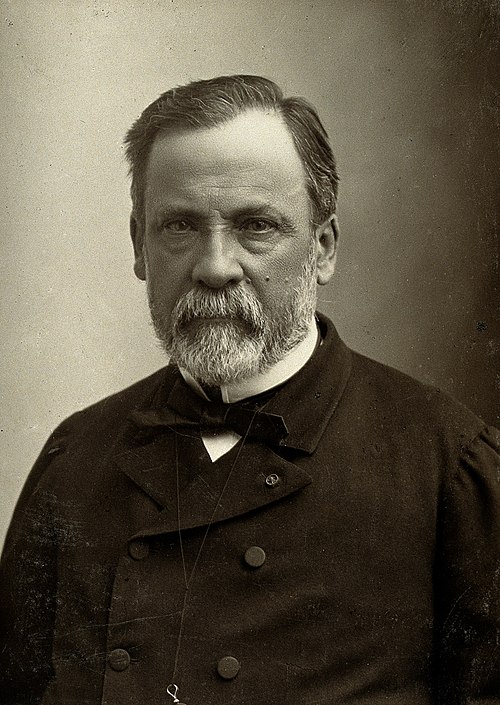
Louis Pasteur
Louis Pasteur
1822 — 1895
France
French chemist and biologist (1822–1895), founder of modern microbiology. He demonstrated the role of microorganisms in diseases and fermentation, revolutionizing medicine and hygiene. His discoveries led to the development of vaccines and pasteurization.
Famous Quotes
« Chance favors the prepared mind. »
« There is no science without passion. »
Key Facts
- 1858: demonstrates that fermentation is caused by living microorganisms
- 1876: establishes the link between microbes and infectious diseases (germ theory)
- 1881: creates the first rabies vaccine and successfully tests its effectiveness
- 1885: vaccinates Joseph Meister, a child bitten by a rabid dog, saving him from death
- Develops pasteurization, a heating technique to eliminate microbes in food and drinks
Works & Achievements
By demonstrating that fermentations are caused by living microorganisms rather than purely spontaneous chemical processes, Pasteur laid the foundations of microbiology and modern medicine.
Pasteur definitively proved that a sterile liquid does not spontaneously spoil if the air entering it is filtered, putting an end to a scientific controversy several centuries old.
A moderate heating technique used to destroy pathogenic microorganisms in wine, beer, and milk. This method revolutionized food preservation and is still universally used today.
By discovering that an aged and weakened culture of the cholera bacillus immunized chickens against the disease, Pasteur generalized Jenner's principle of vaccination and opened the way for modern vaccinology.
Developed and publicly tested at Pouilly-le-Fort, this vaccine saved millions of livestock animals and spectacularly demonstrated the validity of the principle of vaccination using attenuated agents.
The first successful application of a rabies vaccine on a human, administered to Joseph Meister. This landmark discovery, celebrated worldwide, brought Pasteur international renown and led to the founding of the Institut Pasteur.
Anecdotes
In 1885, Joseph Meister, a 9-year-old boy bitten by a rabid dog, was brought to Pasteur. Although not a physician, Pasteur took the risk of administering his experimental rabies vaccine to the child. The boy survived, and this recovery made Pasteur famous throughout the world.
Pasteur was obsessed with hand cleanliness and systematically refused to shake anyone's hand, even dignitaries and ministers. This habit, considered strange by his contemporaries, was in fact consistent with his discoveries about the transmission of germs.
During a spectacular public experiment at Pouilly-le-Fort in 1881, Pasteur vaccinated a flock of sheep against anthrax in front of hundreds of witnesses. Twenty-four vaccinated animals survived, while the unvaccinated controls all died. The public was astounded.
After his first stroke in 1868, Pasteur remained partially paralyzed on his left side. Despite this disability, he continued his research with remarkable energy and made some of his greatest discoveries in this condition, dictating his observations to his assistants.
Pasteur harbored a fierce hatred toward Prussia following the war of 1870 and the loss of Alsace-Lorraine. He returned his honorary doctorate diploma to the University of Bonn and always refused to accept German honors, declaring that science had no homeland, but the scientist did.
Primary Sources
I have sought to demonstrate, through experiments I believe to be irrefutable, that spontaneous generation does not exist; that under present circumstances, inert matter never gives rise to life.
We have found that cultures of this microbe, after aging in air, lose their virulence while retaining their culture properties, and that animals inoculated with these attenuated cultures subsequently resist inoculation with virulent cultures.
Joseph Meister, aged 9, had been bitten on the hand, legs, and thighs in 14 places, so deeply that walking was difficult for him. The most serious bites were 60 hours old. The death of this child seemed inevitable; I resolved, not without acute and painful anxiety, to try on Joseph Meister the method that had consistently succeeded in dogs.
Heating wine to a temperature between 55 and 60 degrees Celsius destroys the ferments that cause its spoilage, without appreciably altering its taste qualities. This method constitutes a practical and effective means of preservation.
Key Places
Birthplace of Louis Pasteur, born on December 27, 1822. His childhood home is now a museum retracing his early years and beginnings.
Pasteur completed his higher studies there, then taught and set up his first major laboratory. It is here that he conducted his decisive research on spontaneous generation.
Founded in 1888 through an international public subscription, this institute is the crowning achievement of Pasteur's career. He spent his final years there and is buried in a magnificent crypt.
Village where Pasteur carried out his famous public vaccination experiment against anthrax on sheep in 1881, before the eyes of the press and the international scientific community.
Town where Pasteur grew up and to which he returned every summer to recharge. He owned a house there that is now a museum, and it is where he suffered his first stroke in 1868.
Gallery

Swedish: Porträtt av Louis Pasteur, studie Study for the Portrait of Louis Pasteurtitle QS:P1476,sv:"Porträtt av Louis Pasteur, studie "label QS:Lsv,"Porträtt av Louis Pasteur, studie "label QS:Lfi,
Wikimedia Commons, Public domain — Albert Edelfelt

The birthplace of Louis Pasteur. Oil painting.
Wikimedia Commons, CC BY 4.0 — Inconnu

Louis Pasteur, proponent of the 'germ' theory of disease.
Wikimedia Commons, CC BY 4.0 — After Albert Edelfelt

Louis Pasteur. Photograph after a painting by Louis Edouard
Wikimedia Commons, CC BY 4.0 — Inconnu

M. Pasteur and His Grand-Daughter, from the painting by L. Bonnat
Wikimedia Commons, Public domain — Léon Bonnat

Quai Maréchal de Lattre de Tassigny, Sète 02
Wikimedia Commons, CC BY-SA 3.0 — Christian Ferrer

Louis Pasteur, foto av Paul Nadar, Crisco edit
Wikimedia Commons, Public domain — Paul Nadar

Louis Pasteur statue, San Rafael High School
Wikimedia Commons, Public domain — Photograph: Sapphic, (Sculptor - Beniamino Benvenuto Bufano (1898–1970))

Louis Pasteur statue, San Rafael High School (crop)
Wikimedia Commons, Public domain — Photograph: Sapphic, (Sculptor - Beniamino Benvenuto Bufano (1898–1970))

Lille monument a louis pasteur
Wikimedia Commons, CC BY-SA 4.0 — Velvet
Liens externes & ressources
Références
Œuvres
Théorie germinale des maladies infectieuses
1857-1863
Réfutation de la génération spontanée (expériences des fioles à col de cygne)
1859-1861
Pasteurisation
1863
Vaccin contre le choléra des poules
1880
Vaccin contre le charbon
1881
Vaccin contre la rage
1885