David
David
1038 av. J.-C. — 968 av. J.-C.
Monarchie unifiée d'Israël et Juda
David is a major figure in the Hebrew Bible, the second king of Israel and Judah (c. 1038–968 BCE). Famous for his victory over the giant Goliath and for his psalms, he unified the Israelite kingdoms and established Jerusalem as the religious capital.
Famous Quotes
« The Lord is my shepherd; I shall not want (Psalm 23, verse 1) »
« Who is this uncircumcised Philistine that he should defy the armies of the living God? (1 Samuel 17, verse 26) »
Key Facts
- c. 1040 BCE: David is born in Bethlehem, son of Jesse
- c. 1025 BCE: David defeats the Philistine giant Goliath with a sling and a stone
- c. 1010 BCE: David becomes king of Israel after the death of Saul
- c. 1000 BCE: David conquers Jerusalem and makes it the capital of the unified kingdom
- The Book of Psalms: traditionally attributed to David, an important work of religious poetry
Works & Achievements
The legendary confrontation in which David, a young shepherd, defeats the Philistine giant Goliath armed with nothing but a sling and a stone. This event becomes foundational to his political authority and marks a turning point in the struggle against the Philistines.
David achieves the political unification of the twelve tribes of Israel and the kingdom of Judah, creating a unified and strengthened state. This unification lays the foundations for a kingdom that would dominate the region for several generations.
David captures Jerusalem and makes it the political and religious capital of his kingdom, installing the Ark of the Covenant there. This decision transforms Jerusalem into the spiritual center of Judaism.
The composition of a major collection of liturgical poems and prayers attributed to David, incorporated into the biblical Book of Psalms. These texts become foundational to both Jewish and Christian religious practice.
David establishes a centralized administration with an organized royal court, a standing army, and a system of governance that serves as a model for the kingdoms of the Levant. This structure endures beyond his reign.
David leads a series of military conquests that extend Israelite territory to the Euphrates, subduing the Philistines, Moabites, and Arameans. These victories establish Israel as a major regional power.
David establishes a royal dynasty whose prestige endures for several centuries and becomes a messianic reference in Jewish tradition. The concept of the Messiah is associated with a future descendant of David.
Anecdotes
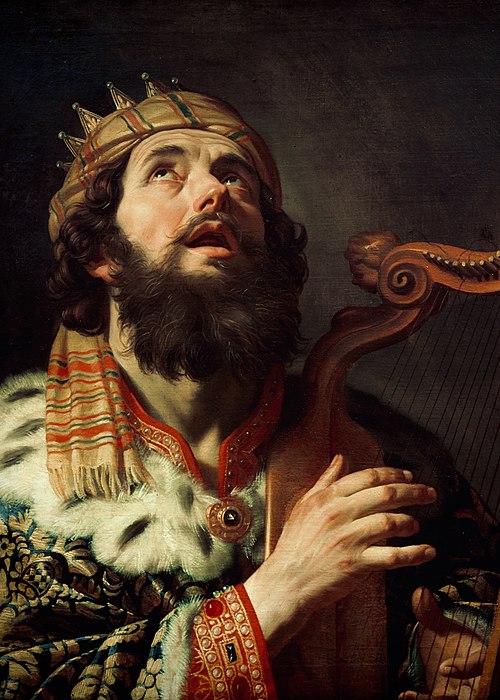
David, a humble shepherd from Bethlehem, was summoned to the court of King Saul to play the harp and soothe his fits of melancholy. His music became so celebrated that David quickly won the affection of the people and became the closest friend of the king's son, Jonathan. It was at court that David discovered his military talents and began his rise to power.
According to biblical accounts, David defeated the giant Goliath, champion of the Philistines, armed with nothing but a sling and stones. This spectacular event marked a turning point: David became a national hero and earned the name 'giant-slayer'. This victory symbolizes the triumph of courage and faith over brute strength.
David established Jerusalem as the capital of his unified kingdom around 1000 BCE, transforming this small fortress into a major political and religious center. He built the Royal Palace there and had the Ark of the Covenant transferred to the city, consolidating both religious and political power in one place.
David is said to have composed or inspired the Psalms, a collection of 150 liturgical poems that became the heart of Jewish and Christian prayer. These texts, attributed to David the 'poet-king', express faith, repentance, and praise, and are still used in religious services to this day.
Despite his military successes, David committed adultery with Bathsheba, the wife of one of his generals, which brought him into conflict with the prophet Nathan. This episode, recounted in biblical texts, shows that even the greatest kings are not exempt from human weakness and divine punishment.
Primary Sources
David said to the Philistine: "You come against me with sword and spear and javelin, but I come against you in the name of the LORD Almighty, the God of the armies of Israel, whom you have defied."
David captured the fortress of Zion — the City of David. And David became more and more powerful, because the LORD God Almighty was with him.
The LORD is my light and my salvation — whom shall I fear? The LORD is the stronghold of my life — of whom shall I be afraid?
[mention of the] house of David, confirming the historical existence of David and his royal dynasty
Key Places
David's birthplace according to biblical tradition. This is where he was born and grew up as a shepherd before becoming king of Israel.
The capital established by David after his conquest. He built the royal palace there, and the city became the political and religious center of the unified kingdom.
The site of the famous battle where David, a young shepherd, faced and defeated the giant Goliath — a founding event of his legend.
The city where David reigned as king of Judah for seven years before conquering Jerusalem and unifying the Israelite kingdoms.
The site of the Temple of Jerusalem, associated with David who prepared its construction and installed the Ark of the Covenant there — a symbol of royal and religious power.
Gallery

Portret konny Stanisława Kostki Potockiego
Wikimedia Commons, Public domain — Jacques-Louis David

Self-portrait as David with the head of Goliathtitle QS:P1476,en:"Self-portrait as David with the head of Goliath"label QS:Len,"Self-portrait as David with the head of Goliath"
Wikimedia Commons, Public domain — Johann Zoffany

Portrait of Jacques-Louis David
Wikimedia Commons, Public domain — Jérôme-Martin Langlois
Artemisia Gentileschi Self-Portrait as the Allegory of Painting (26218694687)
Wikimedia Commons, CC BY 2.0 — David Short from Windsor, UK

(Albi) Portrait d'une femme - 1934 - Suzanne Valadon HsT
Wikimedia Commons, Public domain — Didier Descouens

Glasgow Green Sculpture Garden - Children At Play (Springtime) Statue - geograph.org.uk - 2033497
Wikimedia Commons, CC BY-SA 2.0 — David Dixon

Glasgow Green Sculpture Garden, James Watt Statue - geograph.org.uk - 2033626
Wikimedia Commons, CC BY-SA 2.0 — David Dixon

Gaia Sculpture by Edward Folkard - geograph.org.uk - 4911049
Wikimedia Commons, CC BY-SA 2.0 — David Dixon

Children of Lir Sculpture at The Garden of Remembrance - geograph.org.uk - 5201294
Wikimedia Commons, CC BY-SA 2.0 — David Dixon

Cormorants Sculpture, Stone Jetty - geograph.org.uk - 5728938
Wikimedia Commons, CC BY-SA 2.0 — David Dixon