Artemis
Artemis
Greek goddess of the hunt, the moon, and the wilderness, Artemis is one of the twelve major deities of Olympus. Twin sister of Apollo, she embodies independence and remains a virgin according to Greek mythology. She is the protector of young girls and wild animals.
Key Facts
- Daughter of Zeus and Leto, twin sister of Apollo in Greek mythology
- Roman equivalent: Diana, whose cult flourished throughout the Roman world
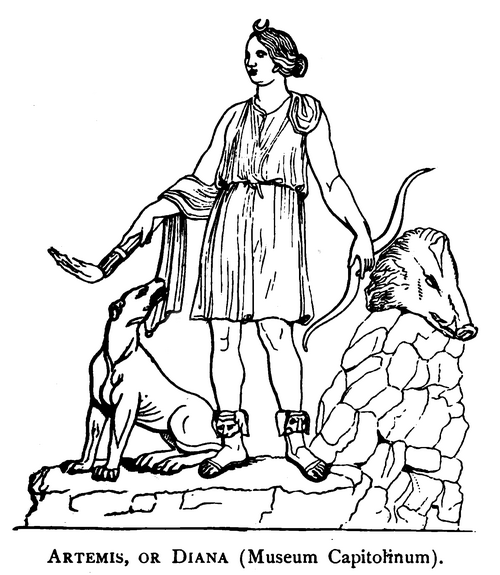
- Depicted with a bow and arrows, symbols of her mastery over hunting and nature
- Protector of young girls and childbirth, venerated in ancient Greek temples
- A major figure in classical Greek literature (the Iliad, the Odyssey, and the tragedies)
Works & Achievements
Artemis is venerated as the protector of girls at puberty and women in childbirth. She represents a refuge for those who wish to remain virgin and independent, embodying feminine autonomy in Greek mythology.
Artemis is the patron goddess of hunting and archery. She is depicted with her bow and golden arrows, symbolizing mastery over the wilderness and warrior precision.
Artemis is identified with the moon and governs the lunar cycle and the night. She guides travelers and sailors, controlling the tides and the natural rhythms tied to the lunar month.
Artemis embodies the protection of wild animals and untamed nature. She is said to punish severely those who hunt without respect or kill her protected creatures, as illustrated by the myth of Actaeon.
According to myth, Artemis transforms the hunter Actaeon into a stag after he stumbles upon her bathing. This story illustrates the goddess's coercive power and her relentless vengeance against transgressions.
Artemis is associated with the Amazons, independent warrior women devoted to hunting and combat. She symbolizes the archetype of strong, self-sufficient women who refuse male domination.
Anecdotes
According to ancient Greek texts, Artemis asked Zeus to remain a virgin forever in order to preserve her independence and freedom. This remarkable request shows how she set herself apart from the other goddesses of Olympus by rejecting marriage. This defining trait was greatly cherished by Greek girls, who sought her protection.
In Homer's Iliad, Artemis is described as the protector of wild animals, especially deer and bears. She is depicted armed with a bow and arrows, making her the most powerful hunting goddess in the Greek pantheon. Hunters would worship her before setting out on a hunt, seeking a successful outcome.
Greek mythology tells that Artemis shared with her brother Apollo the responsibility over the cycles of time: she represented the nocturnal moon while Apollo embodied the daytime sun. This complementarity between brother and sister was symbolized in religious rituals and Greek artistic representations.
Artemis's principal sanctuary was located on Delos, the island of her birth according to mythology. Archaeological excavations have confirmed the existence of temples dedicated to this goddess throughout the ancient Mediterranean world. Greek girls offered sacrifices to her during important ceremonies in their lives.
In the texts of Hesiod's Theogony, Artemis is presented as a fierce warrior capable of protecting her devotees against threats. Though a virgin, she was never weak: she could severely punish those who showed disrespect toward her or her domain.
Primary Sources
Sing, Muse, of the daughter of Zeus, Artemis of the golden arrows, who delights in the din of the hunt. She received from her father a light equal to that of Phoebus, and she roams the shadowy mountains and the wind-swept islands.
Leto bore Apollo and arrow-loving Artemis, most beloved of all the gods, children of her union with aegis-bearing Zeus.
Artemis, fierce virgin, roams the forests with her bow and arrows, accompanied by her nymphs. She will punish anyone who dares to violate her vow of eternal chastity.
Artemis, torch-bearing goddess, friend of the night, queen of the crossroads, protector of young maidens and wild animals, hear our prayer.
Key Places
Greek island considered the birthplace of Artemis and her twin brother Apollo in Greek mythology. A major sanctuary dedicated to the Apollonian and Artemisian deities in antiquity.
Mountainous region of Boeotia associated with Artemis's hunts and rituals held in her honor. A mythological site where the goddess exercised her dominion over the wilderness and wildlife.
A major sanctuary dedicated to Artemis in Attica, where initiation rites for young Athenian girls took place. An important religious center for the worship of the protective goddess.
Mountainous region of Arcadia made sacred by the cult of Artemis. A territory associated with hunting and rituals in honor of the goddess of the wild.
A major city of Ionia home to the Temple of Artemis, one of the most celebrated sanctuaries of the ancient world. A center of pilgrimage and worship of the goddess throughout the eastern Mediterranean.
Mountain range of the Peloponnese associated with Artemis's hunts and religious rituals held in her honor. A wilderness territory symbolizing the divine domain of the goddess.
Gallery

Sacrifice of Iphigeneialabel QS:Lfr,"Le Sacrifice d'Iphigénie"label QS:Len,"Sacrifice of Iphigeneia"label QS:Lca,"Sacrifici d'Ifigenia"label QS:Lel,"Η θυσία της Ιφιγένειας (Αρχαιολογικό μουσείο Νάπολ
Wikimedia Commons, Public domain — Inconnu

Portrait of a Woman as Diana title QS:P1476,en:"Portrait of a Woman as Diana "label QS:Len,"Portrait of a Woman as Diana "
Wikimedia Commons, CC0 — Attributed to Arnaud Vincent de Montpetit (1713-1800)

Self-portraitlabel QS:Lfr,"Autoportrait à la palette"label QS:Len,"Self-portrait"
Wikimedia Commons, Public domain — Sidonie de Polignac

Diana śpiąca.
Wikimedia Commons, Public domain — Wincenty de Lesseur

Diana, statue by Ladislav Beneš
Wikimedia Commons, Public domain — Unknown authorUnknown author

Sculpture of Diana by Reinhold Felderhoff
Wikimedia Commons, CC BY-SA 2.0 — Joey Cross

(Venice) Ancient Roman statues in the Museo archeologico nazionale - Artemis
Wikimedia Commons, Public domain — Didier Descouens

Details of the statue of Artemis Ephesia 01
Wikimedia Commons, CC BY-SA 4.0 — Mehveuuum

Details of the statue of Artemis Ephesia 02
Wikimedia Commons, CC BY-SA 4.0 — Mehveuuum

Artemis Rospigliosi Louvre Ma559
Wikimedia Commons, Public domain — Marie-Lan Nguyen